
Three times the rules changed for local businesses
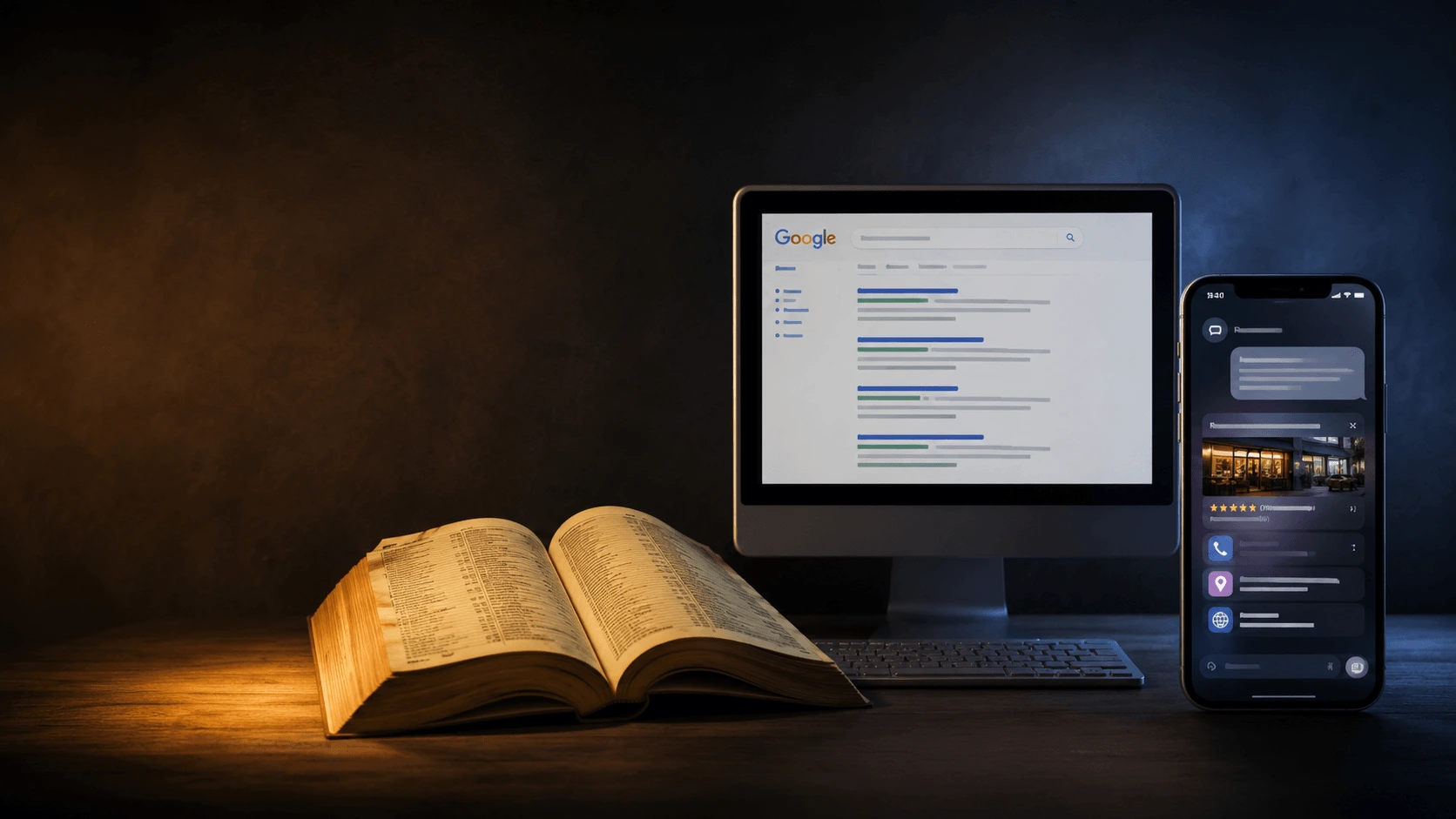
Yellow Pages made businesses findable. Google made websites matter. AI assistants now decide which businesses to recommend. Each shift changed who won and who was left behind. The third shift is happening now.


Hello, I am Rovi Quin. Your AI business guide.
Somewhere in Phoenix, an AC unit broke down last week. The homeowner did not open the Yellow Pages. She did not type into Google. She picked up her phone and asked an AI assistant to recommend a reliable HVAC company nearby.
The AI gave her three names. She called the first one. They booked the job.
Across town, a contractor with fifteen years of experience, dozens of five-star reviews, and a working website did not receive that call. He never knew it existed. No missed call. No bad review. Just silence.
This is not a rare scenario. It is the beginning of a pattern. To understand why, it helps to look at how customer discovery has shifted before.
Era one: the printed page
For most of the twentieth century, the Yellow Pages was the infrastructure of local business discovery. If your business was listed, customers could find you. If it was not, you did not exist in the public record.
At its peak, the Yellow Pages reached most American households. The US industry generated over $14 billion in annual revenue. The listing was the product. Not the size of your ad. Not the quality of your work. The listing. Being in the book was the requirement.
Then the web arrived, and the rules changed almost overnight.
Era two: the search bar
Google launched in 1998. Two Stanford graduate students built a better way to organise the web. By 2011, it was processing over 3 billion searches a day. The Yellow Pages did not decline slowly. It collapsed. Print directory publishers that had been profitable for decades filed for bankruptcy within years of each other.
The businesses that moved first benefited most. A local plumber with a website and a Google Business Profile in 2005 could own the first page of local results for years before competitors understood what was happening. In May 2015, Google confirmed that mobile searches had surpassed desktop globally. The new requirement was clear: website, Google listing, reviews. For twenty years, that was enough.
It is still necessary. It is no longer sufficient.
Era three: the AI assistant
ChatGPT launched in November 2022. It reached 100 million users in two months, the fastest consumer product adoption ever recorded, according to Reuters. By August 2024, OpenAI reported 200 million weekly active users. Google Gemini, Microsoft Copilot, and Perplexity followed on similar trajectories.
These tools did not change how people search. They changed what search produces. A search engine returns links. An AI assistant returns a recommendation. It reads the public information it can find, forms a judgment, and delivers one answer. The user does not browse ten results. They receive one name and make a call.
The invisible loss
When your Google ranking drops, you see the signal. Traffic falls. Enquiries slow. The data tells you something is wrong.
When an AI assistant does not mention you, there is no signal. The customer asked, received an answer that did not include you, called a competitor, and moved on. Your phone did not ring. Your analytics showed nothing. You did not receive a call that could have been yours, and you have no way of knowing it happened.
The loss is invisible. It does not generate a complaint. It accumulates silently.
What AI actually needs
AI assistants do not index websites. They interpret public information layers. They look for consistency, clarity, and structure. When they find it, they recommend with confidence. When they do not, they move to a business that is easier to understand.
Most local businesses were not built with this in mind. A business name appears differently across platforms. Hours are current on the website but outdated elsewhere. Structured data is missing or incomplete. The business that gets the call is not always the best one. It is often simply the clearest one.
The Yellow Pages era required a listing. The Google era required a website. The AI era requires a structured, machine-readable public presence that AI systems can read with confidence. The businesses that build it first will hold the same advantage the early Google movers held. That window existed for a few years. Then it closed. Rovipages is that presence. A listing built for the AI era, so AI systems can understand, trust, and recommend your business.
Be clearer. Not louder.